"Real Artists Ship"

Colin Johnson’s blog


Archive for the ‘Language’ Category

Incomprehension (1)

Wednesday, October 22nd, 2014

A while ago I had a conversation with a colleague, that went something like this:

Me: “I’ve come across a new book that would be really useful to you for the module you’re teaching next term.”

Colleague: “I don’t really think I need that.”

Me: “No, it’s really good, you will find it really useful.”

Colleague (rather angry): “I appreciate your suggestions, but I REALLY DON’T NEED A BOOK ON THE SUBJECT.”

It eventually transpired that my colleague was interpreting “you will find this book useful” as “Because you don’t know the subject of the course very well, you will need a book to help you learn the subject before you teach it to the students.”. By contrast, I was meaning “you will find it useful as a book to recommend to your students“.

This subtle elision between “you” being taken literally and being used in a slightly elided way to mean “something you are responsible for” is easily misunderstood. Another example that comes up frequently is when I am discussing with students some work that they have to do on a project. I will say something like “you need to make an index of the terms in the set of documents”, using the common elision in software development of “you need to” to mean “you need to write code to”, not “you need to do this by hand”. Most of the time the students get this, but on a significant minority of occasions there is a look of incomprehension on the student’s faces as they think I have asked them to do the whole damn tedious thing by themselves.

Significant (1)

Thursday, October 2nd, 2014

I really really really wish we hadn’t settled on the term “statistically significant”. There’s just too much temptation to elide from “these results show that situation X is statistically significantly different to situation Y” to “the difference between X and Y is significant” to “the difference between X and Y is important”.

Statistical significance is about deciding whether it is reasonable to say that the difference between two things is not due to sampling error. Two things can be statistically significantly different and the magnitude of the difference of no “significance” (in the day-to-day sense) to the situation at hand.

We really should have gone for a term like “robustly distinguishable” or something that doesn’t convey the idea that the difference is important or large in magnitude.

Sp. (1)

Saturday, September 20th, 2014

Oh for God’s sake Grauniad, learn the difference between a “physician” and a “physicist”:

"he does not sound much like a theoretical physician"

Next time I get theoretically ill I’m certainly going to a theoretical physician.

Making Sense (1)

Monday, August 25th, 2014

Oddly, this sentence from a colleague’s email makes perfect sense:

Just to confirm that this meeting has been cancelled because it has already taken place.

“In Anger”

Wednesday, July 30th, 2014

I’m surprised at the number of people who don’t know the phrase “used in anger”. Also, if you use it at the person you are talking to doesn’t know what you are taking about, it sounds like quite a nasty accusation: “no, of course I’ve never got angry about this, what sort of person do you think I am?”.

“Because”

Friday, February 14th, 2014

Language shifts are interesting. Double language shifts in a short time, even more.

Over the last couple of years, there is a little idiom that has appeared in English, which is the use of “because” followed by a noun—no proposition, no explanation, indeed often repeating a word in the previous sentence. For example, “I’m going to stop at the chocolate shop on the way home, because chocolate.”. This had a clear meaning, that of saying that the action is actually self-evident; it isn’t just lazy leaving out of some parts of the explanation. The above sentence means something like “I’m going to stop off at the chocolate shop on the way home, because, well, if I have to explain to you why getting chocolate is a good thing then there must be something wrong with you.”. You can almost hear someone saying it “because…….(long pause to try and think of an explanation)………chocolate”. “Because because” is a similar expression. There is a decent attempt to explain the linguistics behind this by Geoff Pullum on a recent language log article.

Interestingly, after a couple of years of this having quite a specific meaning, it is now starting to influence the day-to-day use of “because”, and we are starting to see the use of “because NOUN” as a simple lazy compression. Take this real-world example from a blog comment: “You’re not depressed because single.”. Contrasted to the above example, where the sentence essentially contains the same meaning as “I’m going to stop off at the chocolate shop on the way home.”, the recent example cannot cut off everything before the “because” without changing the substantive meaning: “You’re not depressed.” doesn’t have anything like the same meaning. I have collected a couple more examples just in a few days of noticing this: “The kids are encouraged to misbehave because good TV.”, “…we ate plum pudding on the 21st of December because Jewish.”.

In the course of a couple of years we have gone from creating an interesting new idiomatic expression to it being on the point of vanishing!

Terms of Art (1)

Sunday, January 19th, 2014

In most areas of human endeavour, we adopt words that have an everyday meaning and use them as the basis for terminology. For example, in physics, we talk about sub-microscopic objects having “spin” or “colour”. By this, we don’t mean this in a literal way, but we adopt these terms because we need to find names for things, and so we find something that is very loosely similar, and use that terminology. This doesn’t subsequently mean that we are allowed to take other properties of these labels and reason about the objects using those other properties (an elision that often seems to occur when word-drenched literary theorists wade into discussions of science).

When the day-to-day and technical usages of a word coincide, we can sometimes end up in a muddle. A couple of years ago I set a programming assignment about card games, and I used the word “stack” of cards. Despite being very careful to explain that this use of the work “stack” was not meant to imply that this piece of data should be represented by the data structure known as a “stack” (and, indeed, was best not), I still got lots of questions about this, and lots of submissions that did confuse the two. Perhaps I should have simplified it—but, there was a valuable learning point about requirements elicitation to be learned from leaving it as it was.

Another example is the UK government report from years ago that talked about the UK needing a “web browser for education”. This got lambasted in the technical press—why on earth would the education sector need its own, special, web browser? Of course, what was meant was not a browser at all, but some kind of portal or one-stop-shop. But, this could have caused a multi-billion pound procurement failure.

I think that we have a cognitive bias towards assuming that the person we are talking to is trying to make some precise, subtle, point, even when the weight of evidence is that they have simply misunderstood, or been unfamiliar with terminology.

I try to be aware of this when I am the non-expert, for example, when dealing with builders or plumbers.

This is a great danger in communication between people with different backgrounds. The person who is unfamiliar with the terminology can accidentally wade in looking like they are asking for something much more specific than they intended, because they accidentally use a word that has a technical meaning that they don’t intend.

Declension (1)

Wednesday, November 27th, 2013

Shouldn’t that be “Habemus Pizzam”? (from Vatican City)

Pizza place called "Habemus Pizza" from the Vatican

Making (1)

Wednesday, November 27th, 2013

“What have you been doing?” “I’ve been Sugruing a duckhead”

IMG_1063

Snowclone (1)

Friday, September 20th, 2013

I wonder how many organisations have thought that “X Matters” is a really good name for a newsletter or blog? I can think of at least three. The “ah-ha” moment of realising that “matters” is both a noun, meaning “the concerns of”, and a verb, meaning “has significant influence/importance/interest” is a very powerful draw.

HFSP Matters

Non-English English (1)

Friday, September 20th, 2013

There is an interesting document called A Brief List of Misused English Terms in EU Publications, which lists a mixture of quasi-English Eurocrat terms of art and commonly used English expressions that no native speaker would use.

This includes a number of perfectly reasonable variant usages of the English language which have a particular connotation (e.g. “adequate”, which tends to be used in native English to mean “just about okay” rather than “matching all requirements”; “Anglo-Saxon”, which has a rather pejorative sense in native English); words that have a fairly general meaning (like “agent”) which are only really used in a small number of contexts (“secret agent”, “newsagent”—a joke which my friend Matthew Jarron dined out on for years; “aids” which are only helpful inanimate objects and not helpful people or actions); grammatical formations (like “planification” and “to precise”) that could exist in English but don’t; words that sound as if they could be English but aren’t (“fiche”); and, truly sui generis examples like “comitology” for “committee practice”.

It is interesting to note such examples from day-to-day usage too. That is, not one person’s random misunderstanding, but expressions that are part of a “European English”. For example, in travelling around Europe and speaking to non-native speakers, I frequently come across the following:

  • Cocktail as the name of an event where drinks and canapés are served (often not, even more weirdly, cocktails). Almost every event that I go to around Europe has something labelled on the programme as a “welcome cocktail”, “farewell cocktail” or similar. This isn’t just the metonymic use of the drink for the event, like “welcome beer”; people say things like “Are you going to the cocktail?”, clearly using “cocktail” to denote the event itself. We usually call this a “reception” in native English; this also has the connotations of something that will be a fairly brief event, a pre-dinner or pre-departure event lasting an hour or two, contrasted with, say, “party” which could go on all night.
  • Typical (often spelled “tipical”) to mean “from the region”. “Typical buffet” or “typical specialities” are often to be found in restaurants and hotels. We don’t say this in native English, preferring “local” or the actual name of the region: “Cornish specialities” (which is still a bit naff and olde tyme).
  • Menu to imply a fixed-price limited-choice meal. We don’t really do this in England/Scotland. The main exception is in fast-food places, which adopt the Americanised use of “meal” (“I’ll have a BigMac Meal, please” (perhaps substituting “innit” for “please”)), or (in Scotland) use the word “supper” (“A haggis supper, please”), or just use the full name (“Spam fritter and chips, please”).
  • In travel to mean “travelling”. “I can’t see you next week, I’m in travel until next Thursday” is a popular sort of expression. The choice of whether to use a straightforward noun or a gerund, whether to use a preposition, and then which preposition to use, is a great challenge even for advanced non-native speakers.
  • Interessant sounds like it could be English, and is particularly confusing to speakers of lots of Euro-languages because it is used (in some spelling or other) for “interesting” in most other parts of Europe, both from the Romance and Germanic side: French, German, Spanish, (…turning to Google Translate…) Swedish, Dutch, Romanian, Albanian, Maltese, Bulgarian, …
  • Funny used as adjective to mean “creating a feeling of fun” rather than “entertaining”. “Ballroom dancing is funny” would mean in English-english “I think it is hilarious watching ballroom dancing” and never “I have fun doing ballroom dancing”.
  • ..and the idea that Handy isn’t English slang for mobile phone, despite being an English word, must be terribly confusing to native German speakers.

Any other examples?

Language Change (1)

Saturday, June 29th, 2013

Increasingly seeing the word “staffs” as the plural of “staff”; example:

Academic staffs are requested to robe in the Common Room, where administrative staff will be in attendance to assist you.  All staff members should be at the Common Room no later than the times stated on the list.

Weirdly (or, whilst we’re on the topic of language change, perhaps that should be “wierdly”) the word is used “correctly” later in the same sentence.

“Wear”

Tuesday, March 20th, 2012

The word “wear” seems to be used for an increasingly wide range of things. We used to say of someone with a beard that they “had” a beard, now it seems increasingly common to talk about “wearing” a beard. This makes me think of those false beards that people use when they are pretending to be Santa Claus.

Now, today, I’ve come across the notion of wearing a handbag, (as part of my copious trawling the web for handbag-related webpages). This seems equally incongruous, bringing to mind it sitting around someone’s neck like a necklace.

Self-reinforcing Criticism

Tuesday, October 25th, 2011

There is an interesting rhetorical move that I notice increasingly, which we might refer to as self-reinforcing criticism. An example of this is given in one of Edward De Bono’s books: a caricature of a Freudian analyst argues that some negative trait that someone has is due to their repressing some aspect of their personality. The person being criticized has very little in the way of response. Either they agree, or they disagree. If they disagree then that can itself be used as evidence of even deeper repression!

A common use of this is in planning processes in organisations. A complex proposal will be presented, which is roundly criticized for a number of reasons. However, rather than taking on the criticisms, the person presenting the argument counters with the argument that the critics are just “afraid of change”.

We need a term to “call out” this kind of specious argument. I have experimented by called out the emotional aspects of it: “why are you in a position to know how I am feeling?”. But this isn’t ideal. We need a term of art to describe this, and then to create a pejorative sense to that term. Perhaps a term for this already exists in rhetoric somewhere?

Relatedly, there is a phenomenon where a complex proposal will be presented and, if it is attacked, the proposer will say “well, what do you suggest instead?”. This is difficult to respond to, as the proposer is in the position where they have had days, weeks or months to prepare their proposal, whereas the off-footed opponent has a matter of seconds or minutes. I wonder if we should be working harder to make multi-alternative proposals to be both normal (so that proposals with only one alternative are seen as weak) and acceptable (so that presenting proposals with multiple alternatives are not seen as being weak and indecisive).

Shibboleth (1)

Wednesday, September 21st, 2011

It is commonly stated that in-groups within e.g. careers or activities use specific language as a way of ensuring the coherence of the group and to exclude outsiders. I’m not too sure how reasonable this is—I can see some examples of it, but the argument often just boils over into the whole “all jargon is just obfuscation” argument, which seems wrong to me.

However, there is a variant on this which I think is more interesting. That is, the use of specific generic terms by people within a group. Comedians always refer to the places that they work in as “rooms”, and people in the theatre talk about “spaces”. IT people call computers “machines”. Classical musicians refer to the individual bits of music as “pieces”, and in music theatre the words are called the “book”. Is it possible that these specific choices act as these kind of in-group markers? Or is that just arbitrary—you have to call it something, and so you end up settling on one specific term? But, that argument seems a little flaky—there are also some perfectly good non-generic terms that could be used instead, that are if anything more informative—e.g. “computer” rather than “machine”.

I wonder if this has been studied properly at any point?

Circumspect

Wednesday, August 31st, 2011

Just realised that I’ve been misunderstanding the word “circumspect” all of my life. I had always assumed that it meant looking at something briefly or superficially, but looking it up after seeing it in a context where that doesn’t work, I realise that it means more-or-less the opposite: looking carefully at all aspects of a situation. This illustrates a danger with trying to understand words from their etymology—I had assumed that it meant “looking just around the edge of something” like the use of “circum” in “circumference”, not “looking at something from all aspects”.

Honestly,…

Monday, December 13th, 2010

Is it the case the people who habitually begin sentences with “Honestly speaking…” and similar phrases are usually lying/manipulating what they say – and expect that everyone else is doing the same?

Next Door to the Tonic-Clonic Bazaar

Wednesday, December 8th, 2010

A bizarrely-named vending machine from Japan. I can understand that “petit mall” kinda makes sense as the name of a vending machine, but the weird riff on a dated piece of medical terminology for an epileptic seizure is odd.

Vending machine: "Petit Mall"

Extreme Care and Delicacy

Monday, December 6th, 2010

I think the subtle politeness of this description of a radio interviewer’s booboo is an exemplary example of polite delicacy (quote from BBC News):

Naughtie inadvertently used the first letter of the Culture Secretary’s title to replace the ‘H’ in Mr Hunt’s surname.

Niche Marketing

Saturday, October 30th, 2010

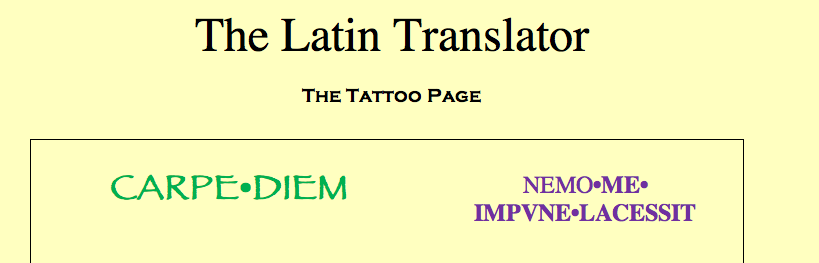
Brilliant example of the kind of long tail marketing that could only be possible due to the internet: a site that provides the service of translating a short phrase into Latin, for use on tattoos. “For US$30.00 we offer what we believe is the only comprehensive Latin translation tattoo service available.” Kinda like the old joke that if you pick three words at random you have an internet business opportunity.

Latin Tattoo page